
Hawkstone Park History Lesson By Jack Burnicle
During the second half of the twentieth century, the history of Hawkstone Park was almost inextricably entwined with the British 500cc Motocross Grand Prix. 21 such contests raged round the rough, tough sandstone circuit, the first during the inaugural year of a European Championship in 1952.
Hawkstone Park also hosted half a dozen dramatic 250 GPs in the 1970s and ’80s, two 125 GPs in 1976 and 1989 and, more recently, has concentrated on an outstanding early-season international established in 1999.
But the venue actually started life as a pre-war hill-climb back in 1938, run by the quaintly-named Crewe and Nantwich Light Car Club! The winner was the driver who made it furthest up the awesome hill which remains the single most breathtaking feature of the track to this day.
In 1946 motorcycle scrambling hit Hawkstone Park courtesy of the Salop Motor Club. In those days heats weren’t necessary. Riders competed under the same rules as the hill-climbers in their cars. Those who made it furthest up the precipitous incline qualified to race! Remember, the hill once climbed further and more steeply than it does now and bikes ranged from 350lb four-strokes like Matchless and BSA to eight brake-horsepower, Villiers-engined two-stroke flyweights like Dot and Francis Barnett.
Harold Johnson, whose son Tony subsequently took over as secretary of the Salop Club, became clerk-of-the-course, a post he eventually handed on to Tony the year they landed their first 250 GP in 1977. The club netted its first national meeting in 1951, the victors that day Bill Barugh on a 125 Dot and Geoff Ward on his mighty factory AJS.
In 1952 the FIM launched its individual European Motocross Championship. Brian Stonebridge (Matchless) won inaugural British Grands Prix at Nymphsfield, in Gloucestershire, and a year later at Brand Hatch, in Kent. Then, in 1954, came Hawkstone Park’s turn. 33000 tickets were sold before they ran out, at an admission price of three shillings and sixpence – that’s 17.5 pence in today’s shrapnel. The track was longer then. At a mile and a half, it included land beyond the sandpit which is now the West Midlands Shooting Ground. Beefy four-strokes were clocking 70 miles an hour along the relatively smooth straights, only the hill and the sandpit reducing average speeds to a still heady 40 mph!
The single 15-lap race featured 23 riders representing five countries, but didn’t include future five-time winner Jeff Smith, who’s Dad considered him too young for such a dangerous track. The boy won a 350cc support race instead. A tremendous duel for supremacy between Geoff Ward (Matchless) and the great Belgian Auguste Mingels (FN) ended when Ward crashed while in the lead. Mingels went out with carburation problems, Brian Stonebridge had to quit with a thumb injury and a swift young Swede called Bill Nilsson – destined to become the first ever World Champion five years later – crashed out in the closing stages.
All of which, after 31 minutes and 23 seconds of relentless attrition, left Phil Nex to head home a British clean sweep chased by Dave Curtis (Matchless), David Tye (350 BSA), Les Archer (Norton) and Terry Cheshire (350 BSA).
The occasion was such an overwhelming success that the rocky sandstone course hosted the country’s premier motocross happening for the next ten years. Even bigger crowds swarmed into Hawkstone Park in 1955 to witness the first grand prix ever to be decided on the aggregate result of two motos. The also saw a triumphant British GP debut for young Yorkshire-born Brummie Jeff Smith, barely out of his teens. Smith was destined to win a fantastic five times at Hawkstone, adding to his initial success in 1957, 1959, 1963 and, en route to his second World title, in 1965.
In 1955 Jeff was followed home by five fellow Brits, seventh-placed Bill Nilsson the first foreign finisher. And he wasn’t the only Englishman to conquer the savage sandstone castle on his way to championship honours. Hampshireman Les Archer (Norton) did likewise in 1956, beating reigning European champ Johnny Draper, who he had deposed by the season’s end. A year later Archer placed second to the Gold Star BSA of Smith, but it was only a matter of time before that other great scrambling nation, Sweden, butted in. Lars Gustafsson (Monark) lifted the laurels in 1958, ahead of the man who took the European crown that year, Belgian Rene Baeten (FN), in a particularly crushing contest which saw only six hardy heroes actually qualify as finishers!
Jeff Smith retaliated for the homeland in 1959 before Bill Nilsson (Husqvarna) pulled off another Swedish sensation en route to his second World title in 1960. Throughout the fifties, huge crowds had poured into Shropshire to enjoy these epic events and in 1960, after Brian Stonebridge had been tragically killed in a motoring accident, Hawkstone Park instigated their annual Brian Stonebridge Memorial Trophy race and attracted a staggering 54000 paying spectators! That’s right: fifty-four thousand.
Matchless-mounted Dave Curtis won both motos in 1961 and Swedish iron man Rolf Tibblin (Husqvarna) did the business twelve months later, beating his compatriot Gunnar Johansson. Then Smith returned in style in 1963 on his new, lightweight 420 BSA Victor before a Motocross des Nations – won by Great Britain despite the Belgians’ late substitute, a Matchless-mounted kid called Sylvain Geboers – ended that glorious decade of grand prix drama.
By now, however, dust had become a big problem round the soft, sandy circuit. False starts at the MX des nations, which was almost inevitably dominated by newly crowned World Champion Jeff Smith, messed up Eurovision’s planned television coverage. The British 500 GP of 1965 witnessed a fifth and final victory for Smith, who led home Mark Eastwood’s Dad Vic for a BSA one-two in the first heat. Smith’s World title rival Rolf Tibblin, now mounted on a 360cc two-stroke CZ, beat Smithy in the second moto to point a telling finger at the future. And a highlight of the weekend was a demonstration lap by American singing legend Roy Orbison, riding Dave Bickers’ works CZ. Unfortunately, the Big O bailed off in the notorious bombhole, broke an ankle and appeared live on ‘Saturday Night at the London Palladium’ that evening with his foot in a plaster cast!
As well as drawing a veil over Roy Orbison’s brief motocross career, 1965 also marked the last 500 GP to be held at Hawkstone Park for ten years. But after the loss of Dodington Park, near Bristol, the Salop Motor Club stepped in to take over once more in 1975. On a blazing hot July weekend 15000 fans braved billowing dust clouds to whip up frenzied support for teenaged tearaway Graham Noyce, competing in his first 500 GP on a five-speed 400cc Maico. Riding with wild abandon, the blonde bombshell broke through to second place behind reigning World Champion and ‘Flying Finn’ Heikki Mikkola (Husqvarna), who was celebrating his 30th birthday! For thirty mesmerising minutes Noyce fought with Jaak van Velthoven’s monoshock factory Yamaha until he caught a flailing foot in the Maico’s back wheel. Exhausted, the 18 year-old dropped back to finish a brave tenth behind Brad Lackey’s Husqvarna.
Mikkola’s first race win hoisted him back into the title lead after Belgian rival Roger de Coster pulled out unhappy about the dusty conditions. And de Coster’s Suzuki team-mate, Dutchman Gerrit Wolsink, waded past van Velthoven to snatch second. Already a remarkable weekend, that 1975 British GP featured Honda’s first official European works outing! The fabled red ‘fire engine’, ridden by US-based Dutchman Pierre Karsmakers, had already scored second places in the American and Canadian rounds, but swallowed a lungful of Shropshire sand in the first race and retired. The bikes had been flown directly from Japan and the bearded Karsmakers used a spare motor to finish fifth in a gripping second moto. Mikkola led from Wolsink, de Coster and British Open Champion Vic Allan (Bultaco). Noyce crashed. Then in a closing crescendo of contrasting fortunes, Mikkola’s Husky began to slow, it’s air filter choked with sand. The fantastic Finn fought on but de Coster and Wolsink overpowered him in the final minutes and, as Heikki struggled on to his final lap, the smoking Husqvarna gasped to a halt half-way up the famous hill. After frantically trying to kick in the airbox, Mikkola made two further despairing assaults on the climb before de Coster took the chequered flag.
That crucial moment in Hawkstone Park’s history proved pivotal in the World series. With four rounds remaining, de Coster regained a lead he would never relinquish. But overall victory went to his team-mate, Gerrit Wolsink, who voiced his angry disapproval of the dusty conditions. So while the 500 GPs took their disenchanted leave for the next nine years, the 125 and 250cc world championships moved in!
1976 featured the first visit of the fledgling 125 class, current Honda UK boss and Midlands favourite Roger Harvey leading privateer on a Husqvarna. ‘Harv’ placed top six despite joining the exclusive ‘downhill club’ on the final lap of race two when he endoed down the scary descent from the verandah. Tiny World Champion Gaston Rahier swept his Suzuki to victory ahead of Czech challenger Jiri Churavy (CZ). Both men beat another novel Honda entry as US 125 champion Mary Smith tried, unsuccessfully, to win both American and World titles in the same year. Marty managed a third place in race one but lost his chain in race two, when Russian Pavel Rulev (CZ) mounted the rostrum. That day also saw Zdnek Velky throw his CZ a record-smashing 90 feet across the Girling Leap as, without a chicane at the bottom of Hawkstone Hill, the tiddlers attacked the incline on full bore. Unfortunately, Velky’s ebullience broke his CZ’s frame!
The Eastern Bloc turned out in force a year later for Hawkstone’s first ever 250cc grand prix and emerged victorious. Russian Gennady Moiseev, on his way to a second World crown, rampaged to a double win ahead of his KTM team-mate Vladimir Kavinov. In fact, the Austrian factory almost ruled the rostrum, Frenchman Jean-Jacques Bruno third in race one and the great Andre Malherbe grabbing second place in race two ahead of lanky German Hans Maisch (Maico, of course; he was the boss’s son, after all!).
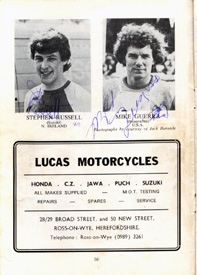
After a two year hiatus, Tony Johnson tempted back the friendly 250 GPs in 1980 and again a man en route to a World title, 19 year-old Georges Jobe (Suzuki), won overall despite Dutch sandmaster Kees van der Ven (Maico) taking race one. In 1981, a second-race engine seizure halted Jobe after he had chased home van der Ven in the first moto. Englishman Neil Hudson (Yamaha), enmeshed in an epic World championship joust with Jobe, finished third in race one then beat van der Ven and American Mike Guerra (Husqvarna) in race two. This was the year the killer whoops were first built on the loop round to the bombhole and Hudson’s team manager Heikki Mikkola stood alongside them indicating a forceful, clenched fist ‘full bore’ to the heroic Englishman, who had little option but to comply!
Georges Jobe refuses even to acknowledge he was at Hawkstone Park in 1982, he had such an awful day! But a duel of the century between his title rivals van der Ven and Danny LaPorte (Yamaha) saw the glamorous Californian take overall honours on a tiebreaker after some astonishing moves, like launching side-by-side into the bombhole, both on the inside line! LaPorte went on to be World Champion that year and Ulsterman Dave Watson, his Yamaha team-mate, upheld British spirit with a dashing third in race one.
Jobe returned once more in 1983 and shared the rostrum with LaPorte and van der Ven, ‘Danny the Door’ snatching another verdict on a tiebreaker but losing his crown to the equally dashing Belgian.


Don Green’s History Of Hawkstone Park
Don Green on the History of Hawkstone Park and included in the programme for the AMCA Classic International held in 2009.
After the war (1939 to 45) Motor Cycle Sport was slow to resume activities due to Petrol rationing and it was several years before clubs could run events. The Salop Motor Club at Shrewsbury which was formed in 1931 and had run Grass Tracks and Trials approached Brigadier Sir Alexander Stanier, Bart, DSO., MC about the possibility of using his ground near Hind Heath. The venue had been used before the war by the Crewe and Nantwich Light Car Club for Hill Climbs. Permission was granted and on March 5th, 1950 the first scramble was held restricted to Midland riders. The Results show E. Purslow winning the 125 c.c. race from a J.V.Smith, both riding BSA’s. Don Evans on a 500 Ariel won the main events and 1000 spectators attended. A second scramble was held on July 23 attracting a similar sized crowd.
1st National in 1951. Around 7000 spectators came to watch this scramble and saw Geoff Ward (AJS) win all 3 main races while Bill Barugh won the 125c.c. on a Dot. He repeated his win in the 52 National with John Avery(BSA) winning the 350 and 500 races and Les Archer on the Norton took the 1000c.c. race. The first lady to compete at Hawkstone was June Lines on May 11th, wife of Harold who also competed.
Dutch Riders Compete in ‘53. Geoff Ward repeated his hat trick of wins in the ‘53 National before a crowd of 15000 and Dutch riders competed for the first time at Hawkstone Park. Henry Rietman won the Hawkstone Championship Trophy while another Dutch rider Jan Clynk broke the lap record only for it to be broken again in the Spring of 54 by Brian Stonebridge riding a BSA.
1st Grand Prix, July 4th. With a crowd estimated to be between 35000 and 40000. One race of 15 laps would decide the Grand Prix which was the British Round of the European Championships. Brian Stonebridge(BSA) led for most of the race but was forced to retire with an injured finger 3 laps from the finish and so Phil Nex (500 BSA) went onto win from Dave Curtis (Matchless), with David Tye (350 BSA) 3rd. Les Archer (Norton) 4th. Terry Cheshire (BSA) 5th and Nic Jansen of Belgium (Sarolea) 6th. John Avery (BSA), 7th followed by B.Andersson of Sweden (AJS), Brian Martin (BSA), L.Sheenan from Australia (AJS). Other riders from aroad included Bill Nilsson (BSA) and Sten Lundin (BSA) from Sweden, Auguste Mingels (FN), Victor Leloup (FN) and Rene Baeten (Sarolea) from Belgium with J.Charrier (BSA) from France. The remaining British riders were Reg Pilling, T.White, John Draper, D. J. Rickman(BSA), and D.Eaves (Royal Enfield). 23 riders competed with 14 finishing and of those only 7 competed the full 15 laps. A new start system was tried using Traffic Lights instead of the flag start.
2nd Grand Prix, July 3rd 1954. The British round was the 4th after Switzerland, France and Italy and more would follow in Belgium, Luxembourg, Sweden and Holland, yet only 8 foreign riders came to Hawkstone. A crowd of over 35000 attended to see Jeff Smith win both races over 10 laps each. In the 1st Smith won from Johnny Draper with Brian Stonebridge 3rd, Terry Cheshire 4th and 5th John Avery, all 5 riding BSA’s with Les Archer 6th on the Norton. 2nd Race and Draper followed brother in law Jeff Smith home with Geoff Ward (AJS) 3rd, Archer 4th, Stonebridge 5th, and Basil Hall on an Ariel 6th.
Hawkstone Park has hosted 30 Grand Prix’s from 1954 till 1999 including the Nations in 1964 won by the Gt Britain team led home by Jeff Smith who won both the 16 lap races, after 4 false starts in the first race, the Rickman brothers riding Matchless Metisses were 2nd and 3rd and Vic Eastwood 6th on a Matchless. Belgium was 2nd with Herman de Soute (Metisse), Sylain Geboers (Metisse). Hubert Scaillet (Metisse), and Roger Vanderbecken (Triumph). 3rd were Holland with Broer Dirks (Lito), J.Heyboer (BSA), B.Hartleman (BSA), Pete Dirks (Lito), and R.Boom (Husqvarna).
The largest attendance at Hawkstone was in 1960 for the first Brian Stonebridge Memorial Scramble. Estimates vary between 40000 and 84000, many people had to park up and walk the last few miles to the circuit. Brian Stonebridge had been killed in a car accident the previous year and had been a leading rider in the 250 c.c. European Championships riding the Greeves Two strokes which he developed. Before moving to Greeves, Stonebridge from Cambridge had ridden for BSA. In 1951 he had finished 3rd in the 500c.c. British Championships riding a Matchless. In the 500 European Championhips he finished 6th in 52, 54, and 55. Riding for Greeves he was Runner up in the 250 c.c. European 1959 Championship to Rolf Tibblin on a Husqvarna. 13 rounds were held, best 7 to count.
The last British rider to win a Grand Prix rider at Hawkstone was Dave Thorpe in 1984 riding for Honda who won both races and the last Grand Prix was run in 1999. Other World Championship events have taken place since with the British round of the World Trials Championship being staged with large crowds attending.
Today’s event is a round of the ECMO – European Classic Motocross Organisation which has run 3 rounds this year for different ages with rounds already held in Germany and Sweden and today’s is the final round. Each year they organise a Nations Team event and this year it’s in Holland on September 12th and 13th at Boekel, last year’s it was held in Finland and was well supported by British riders.
Thanks to the Shropshire Classic club for organising today’s event in fact it’s a full weekend of Classic Racing with a lot of riders competing on British machines just as it used to be here. Special THANKS to Maggie and Terry Challinor, their friends and members of the club for making it possible.
Many THANKS to Brigadier Sir Beville Stanier,Bart,DSO.,MC, the son of the original owner of the venue for allowing the sport to take place on his land and for so many years. Hawkstone is well known throughout the world as the ‘home’ of British Scrambling/Moto Cross.
Organisers of the events held here at Hawkstone over the 60 years are of course the Salop Motor Club whose members (past and present) have put in many hours work at the circuit which has been altered and modified over the years. Many thanks to all the volunteers for their efforts and help. I’ve tried to research the History of Hawkstone Park for inclusion in this programme, there is so much but we have only scratched the surface, but it’s been very interesting. Thanks – Don Green.
Grand Prix’s at Hawkstone Park, Shropshire
| 1954 | 4th July | 500cc | 1st | Phil Nex | (GB) | Ariel |
| 1955 | 3rd July | 500cc | 1st. | Jeff Smith | (GB) | BSA |
| 1956 | 7th July | 500cc | 1st. | Les Archer | (GB) | Norton |
| 1957 | 7th July | 500cc | 1st | Jeff Smith | (GB) | BSA |
| 1958 | 6th July | 500cc | 1st | Lars Gustafsson | (Sweeden) | Monark |
| 1959 | 5th July | 500cc | 1st | Jeff Smith | (GB) | BSA |
| 1960 | 3rd July | 500cc | 1st | Bill Neilsson | (Sweeden) | Husqvarna |
| 1961 | 2nd July | 500cc | 1st | Dave Curtis | (GB) | Matchless |
| 1962 | 1st July | 500cc | 1st | Rolf Tibblin | (Sweeden) | Husqvarna |
| 1963 | 7th July | 500cc | 1st | Jeff Smith | (GB) | BSA |
| 1964 | 26th August | Nations Team | 1st 2nd 3rd |
(GB) (Belgium) (Holand) |
||
| 1965 | 4th July | 500cc | 1st | Jeff Smith | (GB) | BSA |
| 1975 | 5th July | 500cc | 1st | Gerriut Wolsink | (Holland) | Suzuki |
| 1976 | 2nd May | 125cc | 1st | Gaston Rahier | (Belgium) | Suzuki |
| 1977 | 31st July | 250cc | 1st | Gennady Moiseev | (USSR) | KTM |
| 1980 | 22nd June | 250cc | 1st | Georges Jobe | (Belgium) | Suzuki |
| 1981 | 21st June | 250cc | 1st | Kees van der Ven | (Holland) | KTM |
| 1982 | 13 June | 250cc | 1st | Danny La Porte | (USA) | Yamaha |
| 1983 | 19th June | 250cc | 1st | Georges Jobe. B & Danny La Porte | (USA) | |
| 1984 | 21st July | 500cc | 1st | Dave Thorpe | (GB) | Honda (2 wins) |
| 1986 | 12th July | 500cc | 1st | Eric Goebers | (Belgium) | Honda |
| 1987 | 10th May | 250cc | 1st | Pekka Vehkonen | (Finland) | Cagiva |
| 1989 | 2nd July | 125cc | 1st | Trampas Parker | (USA) | KTM |
| 1990 | 8th June | 500cc | 1st | Eric Geboers | (Belgium) | Honda (2 wins) |
| 1991 | 7th July | 500cc | 1st | Dirk Geukens | (Belgium) | Honda |
| 1992 | 5th July | 500cc | 1st Billy Liles | J.Nilsson S & R.Weustenraed B. & D.Geukens B | (USA) | Honda (3 wins) |
| 1993 | 4th April | 500cc | 1st | |||
| 1994 | 15th May | 500cc | 1st | Jacky Martens | (Belgium) | Husqvarna (2 wins) |
| 1997 | 6th July | 500cc | 1st | Joel Smets | (Belgium) | Husaberg |
| 1999 | 11th July | 500cc | 1st | Peter Johansson | (Sweden) | KTM (2 wins) |
Acknowledgement:
Salop Motor Club would like to thank Don Green for compiling this section of the History file.
Postscript:
Since 1999 the financial terms and risks associated with running a round of the FIM World Championship have been so onerous that the Salop Motor Club has not been able to host a Grand Prix.
A number of individual promoters have tried ,and although many of them ran a very successful events it is believed that they all have run into serious financial difficulties.
Lets hope that some form of National level support can be put together to enable the British Grand Prix to return to its traditional home here at Hawkstone Park.